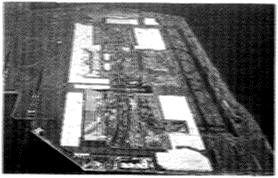
The expansion of Haneda airport into the Tokyo Bay is an example of how the Tokyo Metropolitan has effectively utilized land reclaimed by disposing waste. This is an unprecedented project in terms of having used waste to secure land for an airport. Because the national government was being pressed to increase the capacity of its airports and at the same time reduce noise pollution, the interests of the national and metropolitan government united to developed offshore Haneda airport.
The land was reclaimed by filling the seas with the dredge soil generated from the Tokyo waterfront area, construction demolition debris and ordinary waste.
The airport has been expanded to 1100 hectares, a tripling of its former size. By providing two 3000 meter runways and one 2500 meter runway, the airport can now accommodate 25,500 landings and takeoffs per year. With the increasingly large size of airplanes and the dramatic improvement in transportation capacity, Haneda will ultimately handle 64 million visitors per year.
Tokyo International Airport (Hanoda Airport)
(Photo courtesy of Ministry of Transport Photograph DO URBAN INC.)
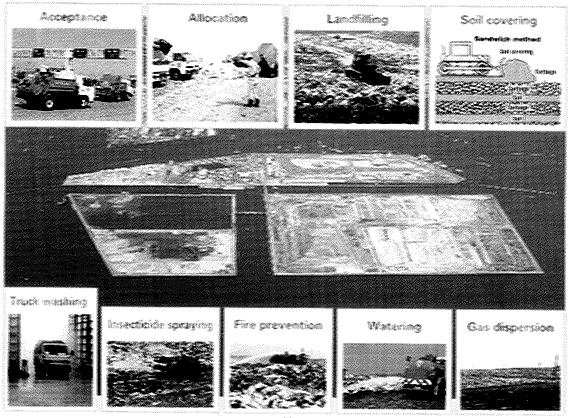
[Internal Chuo Waterbreak (bouhatel). Outer waste treatment facility]
Tokyo Teleport Town has been developed as a new urban space for the 21st century. Adjacent to the area a lush forest occupies 425 hectares of space and stands 30 meters tall, this is the kind of extraordinary cityscape that will be emerging in the 21st century. This space is being created using garbage collected from the Tokyo area. Currently, the Chuo Waterbreak(bouhatei) outer waste treatment facility is the only sea disposal facility in Tokyo where garbage is used to reclaim land from the hay.
The waste treatment process Tbe Chuo Waterbreak(bouhatei)outer waste treatment facility.(Photo courtesy of Tokyo Metoropolitan Govn.)